data files and filegroups per database…
Hi All,
Use the below code to get the data files and groups information per database
SELECT
COUNT (*) AS [DataFiles],
COUNT (DISTINCT data_space_id) AS [Filegroups],4
SUM (size) AS [Size]
FROM sys.master_files
WHERE [type_desc] = N’ROWS’ — filter out log files/data_space_id 0
AND [database_id] > 4 — filter out system databases
AND [FILE_ID] != 65537 — filter out FILESTREAM
GROUP BY [database_id];
GO
Please check and let us know if you have any concerns on this.
Thanks for viewing this.
Regards,
Chaitanya
SCRIPT finding the Size of required tables in Sql Server Database
Hi All,
Today we got one requirement to find the size of given tables in sql database
We have written the below script and its working fine
USE AdventureWorks2012
GO
SELECT t.name
AS
TableName,
p.rows
AS RowCounts,
Sum(((( Cast(a.used_pages AS DECIMAL(18, 4)) * 8192 ) / 1024 ) / 1024 )) AS ‘File Size (MB)’,
Sum(((( Cast(a.used_pages AS DECIMAL(18, 4)) * 8192 ) / 1024 ) / 1024 ) / 1024)AS ‘File Size (GB)’,
Sum((((( Cast(a.used_pages AS DECIMAL(18, 4)) * 8192 ) / 1024 ) / 1024 ) / 1024 / 1024 ))AS ‘File Size (TB)’
FROM sys.tables t
INNER JOIN sys.indexes i
ON t.object_id = i.object_id
INNER JOIN sys.partitions p
ON i.object_id = p.object_id
AND i.index_id = p.index_id
INNER JOIN sys.allocation_units a
ON p.partition_id = a.container_id
WHERE t.name IN(‘ErrorLog’,’DatabaseLog’)
AND t.is_ms_shipped = 0
AND i.object_id > 255
GROUP BY t.name,
p.rows
ORDER BY t.name
Result:

We can get the size of tables in MB,GB’s and TB’s
Thanks for viewing this.
Regards,
Chaitanya
Visit site: http://www.sqlblogging.com
Send an Email: sqlblogging
@@CONNECTIONS and @@MAX_CONNECTIONS in sql server
How to find number of connection attempts to sql server since last restart
@@CONNECTIONS: Global variable is used for finding this information
Syntax:
Select @@CONNECTIONS
Return Typeàinteger
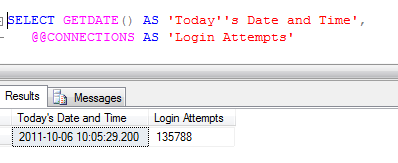
After Sql server instance is restarted we have these many attempts are made to connect to sql server instance and these attempts are success or failed
And it is non-Deterministic as it may return different results each time they are called with a specific set of input values.
We have another global variable @@MAX_CONNECTIONS and this is used to check how many connections can be done to sql server simultaniously
Syntax:
Select @@MAX_CONNECTIONS
Return Typeàinteger
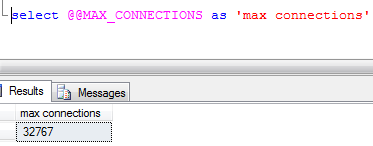
Simultaniosly users can open 32767 connctions to sql server instance
The actual number of user connections allowed also depends on the version of SQL Server installed and the limitations of your application(s) and hardware
Regards,
Chaitanya,
Webiste : https://mssqlbuzz.wordpress.com/
To Send Mail : mssqlbuzz
Searching the strings with leading spaces and trailing spaces in the sql server
Hi Folks,
We have issues in the production at our end where the master table is update with leading spaces and it is causing the incorrect results as it master table and configuration is present in those tables.
I quickly checked the leading spaces in the table using the below query
We have created sample tables for this demo
use tempdb
go
create table #tempo
(
id int,
name varchar(100)
)
insert #tempo
select 1,’chaitu’
union all
select 2,’pradee’
union all
select ‘3’,’ krishna’
select * from #tempo

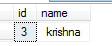
Below is the query for getting the leading spaces in the name column
select * from #tempo where LEFT(name,1)=”
For trailing spaces
use tempdb
go
create table #tempo
(
id int,
name varchar(100)
)
insert #tempo
select 1,’chaitu’
union all
select 2,’pradee’
union all
select ‘3’,’krishna ‘ à trailing space is inserted
select * from #tempo

Below is the query for getting the tralining spaces in the name column
select * from #tempo where right(name,1)=”

Please let us know if you have other options
Thanks for viewing.
Regards,
Chaitanya,
Number of ways to view the tables and views in the sql server
sp_tables is the procedure used for getting the tables and views information in sql server current data base
sp_tables [ [ @table_name = ] ‘name’ ]
[ , [ @table_owner = ] ‘owner’ ]
[ , [ @table_qualifier = ] ‘qualifier’ ]
[ , [ @table_type = ] “type” ]
[ , [@fUsePattern = ] ‘fUsePattern’];
@table_qualifier-database name
@table_owner is the schema name
@table_type- it takes only 3 arguments and will give ouput based on that TABLE, SYSTEMTABLE, and VIEW
[@fUsePattern- for pattern matching
Ex:
exec sp_tables @Table_Type = ”’VIEW”’
exec sp_tables @Table_Type = ”’TABLE”’
normally we have the used below queries for retruing the tables information and views information from the database
first and best option is information schema
for tables
SELECT [TABLE_NAME]
FROM INFORMATION_SCHEMA.tables
For views
SELECT [TABLE_NAME]
FROM INFORMATION_SCHEMA.views
Alternatively, the INFORMATION_SCHEMA.TABLES system view can also be used to return user views.
SELECT TABLE_NAME
FROM INFORMATION_SCHEMA.TABLES
WHERE TABLE_TYPE = ‘VIEW’
The INFORMATION_SCHEMA.TABLES system view returns both view and user tables. To return just user views, the TABLE_TYPE needs to be checked for a value of ‘VIEW’.
The third way of getting a list of user views is by querying the different system views, namely, the sys.views, sys.objectsand dbo.sysobjects.
For views:
Select * from sys.views
SELECT [Name] FROM [sys].[objects] WHERE [type] = ‘U’
SELECT [Name] FROM [dbo].[sysobjects] WHERE [xtype] = ‘U’
For tables:
select * from sys.tables
SELECT [Name] FROM [sys].[objects] WHERE [type] = ‘U’
SELECT [Name] FROM [dbo].[sysobjects] WHERE [xtype] = ‘U’
Please check and let us know if you have any concerns on this
thanks for reading
adding the error message to the event viewer through t-sql
We have the extended stored procedure in the sql server master database
go to object exploerer-> databases-> system databases-> programmability->extended stored procedures
Extended stored procedures are created and loaded using DLL’s (which are created in C/C++), and offer more independent functionality than standard procedures (such as access to the Win32 API, services, direct disk/network etc), and because they’re compiled externally as dynamic linking libraries (DLL’s) and these are very faster
sending the error message to the event viewer functionality is supported by one of the extended Procedure xp_logevent
which is used to send the user defined message to the event viewer through the t-sql
syntax:
xp_logevent {error_number, ‘message’} [, ‘severity’]
The error_number parameter is a user-defined error number greater than 50,000. The message parameter is the actual message that will be shown in the event viewer. Lastly, severity is an optional parameter containing one of three character strings that represents how bad the error that occurred was. The three possible values are INFORMATIONAL, WARNING, and ERROR. If you don’t include this parameter, the INFORMATIONAL is used.
Example:
Exec master..xp_logevent 65000, “User defined Error message”, WARNING
or
use master
exec xp_logevent 65000, “User defined Error message”, INFORMATIONAL

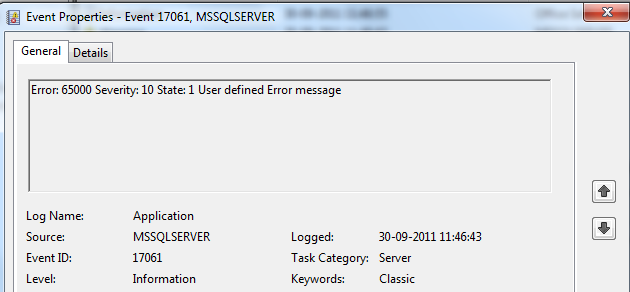
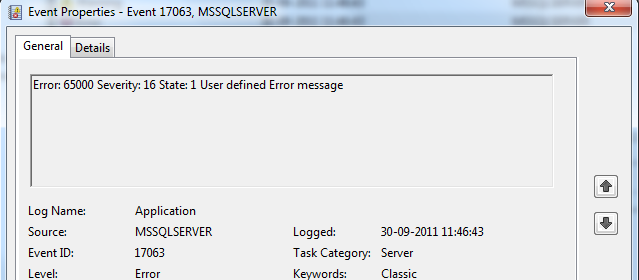
Next, run event viewer (Start -> Programs -> Administrative Tools -> Event Viewer) and click on the application log node. Look at the top couple of lines and find an entry with a source of “MSSQLSERVER”; double-click on it. It should load a property page showing our error message, number, and severity, like this:
you will see the message .

if we double click on these , they are like below

Please let us know if you have any other options for this..
thanks for viewing
increment the string value letter by letter for every row
Hi ,
This is my first post in this blog. yesterday my friend asked me how to display the sting letter by letter in sql server
we have string function substring used here
below is the script for this
use tempdb
go
if object_id(‘tempdb..#temp’) is not null
begin
drop table #temp
end
go
— declaring the variable to store the string
declare @test varchar(100)
set @test=’chaitanya’ — assigning the value to the variable
declare @count int
select @count=len(@test)
declare @i int
set @i=1
create table #temp
(
column1 varchar(100)
)
declare @result varchar(100)
declare @j int
set @j=0
while(@i <=@count)
begin
select @result =substring(@test,@j,@i+1)
insert #temp(column1)
select @result
set @i=@i+1
end
select * from #temp
–result
c
ch
cha
chai
chait
chaita
chaitan
chaitany
chaitanya
Please let me know if you have any concerns or any suggestions
Regards,
Chaitanya

 SQL BLOGGING